Ambalapuzzha :16th May
This morning Jiji brought me a breakfast of coconut pancakes drizzled with jaggary and tea in teapot. In the evenings I am treated to a home-made thaali meal with small bowls of parippu (mixed lentil soup flavoured with tomato and garlic), rasam (peppery lentil broth), kathrika (plantain fritters) and vadai ( small doughnuts made from black lentil batter). For deserts they served me rice noodles, in milk and raisins and always send me to bed with a chilled bottle of mineral water and a mosquito coil. It’s just like living with a family, but with payment.
The Sri Krishna Temple, one of the oldest in Kerala, is a three kilometre walk away. It’s an auspicious time now, a special festival is going on which only happens once every 144 years. Under a glitzy cloth house of tinsel and garlands, priests of all ages and shades of brown, sit in rows bare chested but for a thread. They throw one petal for every Vedic chant which is wired up to loudspeakers so that the auspiciousness of the occasion can be heard by passers-by on the main road. From the size of ridge of fragrant petals in front of them, they have been chanting for quite some days. Inside the temple a man approached me and told me take off my shirt, customary for south Indian temples. I knew this, but I forgot to do it. Spot the tourist!
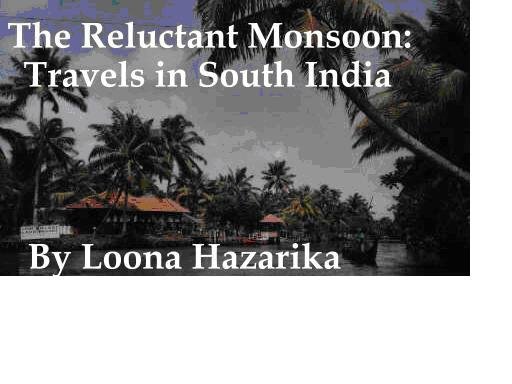
A boatmen rowed me around the waterways for a day; we passed many houses on the banks of the canals, drifting past branches with chameleons hanging on them like green socks on a clothesline, past flooded paddy fields with embankments of tethered goats, overtaking slower boats carrying mounds of green coconuts and ducking in the boat as we passed under low footbridges. An old lady scraped the scales off a fish on the bankside and she waved at us. Ocassionally a palm matted houseboatm which are air-conditioned floating 5 star hotels, would pass us with a party on board. The children were friendly, they would run along the bank and shout “What country?” and “One pen please!”. A threw a pen at them which started a minor squabble. Pens must be valued, in Kerala primary education is compulsory and the literacy rate is about 95%. The standard of living in Kerala is relatively good too thanks in part to the land reforms of the world’s first elected Communist government.
We passed a grove of coconut trees – apparently more people die from falling coconuts than snake bites in Kerala which literally means “Land of Coconuts”. Inspite of their fatal attraction, the coconut tree is the botanical darling of the Malayalis. Coir is made from the fibres of its husk and used to bind their boats which are made from its wood; from its milk, they make a bubbly white country wine called Toddy which is fermented in earthenware pots up a tree (it is an acquired taste, take my word for it); oil is made from its dried coconut flesh (called copra) and used for massages, cooking and hair. No wonder they call the coconut tree the tree gifted from God but sleep under one at your peril, you could be saying a very personal thank you.
The backwaters are a mix of sea water and freshwater. The Malayali people have learned to channels the water types to best advantage, annually letting the sea water in to their fields to kills off weeds and mosquito larvae.
Up ahead two brass vases were bobbing and spinning of their own accord. As we neared them, shrivelled pink fingertips appeared on them and the heads of two old ladies appeared in the water – they were wading for shellfish. A nearby factory heats and crushes the shells to make a white powder, as fine as talcum, which is used as a lime for cement, paintwash and paan.
We berthed in Champakulum a waterlogged village with an ancient church built in 427AD. St Thomas the Apostle is said to have brought Christianity to these shores just after the death of Jesus Christ. I took off my shoes, no need to remove my shirt this time, and then sat in the church on the pew-less floor with the others. They were singing hyms infront of a large statue of Christ next to high walls with murals on them. I looked around and saw that the congregation around me were all women. Two days, two religious places, two mistakes. I was sitting on the women’s side of the church.
Showing posts with label kerala backwaters. Show all posts
Showing posts with label kerala backwaters. Show all posts
Thursday, 17 May 2007

Where can I buy a dhoti?
Fort Cochin to Karumady Village: 15th May
On leaving Fort Cochin, David the owner of the Delight hotel, advised me to go and stay with some of his friends who live in the rural backwaters in the village of Karumady Village. I scribbled down the directions and place names.
The first mode of travel today, a high speed autorickshaw, its driver must have been Kerala’s answer to Evil Kenieval, perhaps narrowly beaten by Vijay Amritraj in getting a role in a James Bond film. From the Ernakulum Bus station it was a short ride to Kotayam where, still rubbing a bump at the top of my head, I asked for the jetty terminal – nobody could understand me. Perhaps it was the way I pronounced “Goo Ma Gun Jetty”. That’s what Davod had said I’m sure. Any small change in inflexion or intonation can change a place name beyond recognition
After asking anyone who could remotely understand me, I arrived at the “Kumarkom” jetty for a 2 hour wait - the ferry to Allapuzha had been cancelled so at a canalside restaurant I ate some idiapam and fried okra. Chartered barges full of partying families from the close-by 5 star holiday resorts went past. Soon the ferry arrived and we sailed in to the huge Vembanad Lake which looked more like a sea but betrayed by the green tinsel of coconut trees that edged the horizon that encircled us. The lake is the venue for the annual Nehru Cup for which crews race each other in “snake” boats, each with 80 rowers, 20 drummers and 15 steersmen. The afternoon winds were up and we dipped our way through the waves till we berthed at a tiny village called Mohama. I asked a group of youths how to get a bus to Alappuzha but they appeared keener to ask questions than to give me a straight answer:
“Which country you are from?”
“ India.”
Confused looks, they stare at me up and down.
“OK then, England.”
More confused looks, staring at me up and down once again.
When a man with betel-stained teeth who reeked of early-afternoon whiskey demanded fifty rupees, I realised it was time to stop the explanation of the Indian community in the UK and just slipped away. On the bus I contemplated the advantages of inconspicuousness in foreign travel. I really need that dhoti.
From Alappuzha, it was only one further bus to Ambalapuzha Junction on National Highway 47 to get to my destination of Karumady Village. The realisation I was off the beaten track came to me when I saw that the destination signboards on the buses were all written in the looping, flowing script of Malayalam. I asked people on the bus “Ambalapuzha Junction?”. And this led to a secondary issue – when people in south India shake their heads, they mean “yes”. It’s not quite a shake, but more a gentle wobble of the chin from side to side, hardly discernible in the franticness of a bus station. The conductor shook his head in this manner, I understood it to mean “no” so shook my head in perceived agreement meaning “no” too, and descended the bus. Only afterwards did a fellow passenger come up to me and say that it was indeed going to Ambalapuzha.
After the bus, an auto-rickshaw sped me through narrow red-earth lanes made redder by the light of a mango-flesh sunset, its reflection rippling in the water of a paddy field. At dusk I arrived at Karumady village and walked over a small footbridge to arrive at the home of Jiji and Trisha Mappilassery and their son John, a family of Christians who rent out cottages on the banks of the river Pumba in what they advertise as “a very private backwater residence”.
There was a powercut and the Mappilasserys were seated on the floor of their living room singing Christian hymns in Malayalam in the bluish light of a paraffin lampd. Jiji showed me to my cottage by the waterside, tranquil and silent but for the splashing fisherman working in the full-moon light and the occasional plop from a diving kingfisher. The land was inherited by Jiji, he got last pick after his 3 brothers and 3 sisters, who wondered considered the strip of land on the banks of the backwaters as useless for growing anything. In his time when he’s not working as a Database Administrator, he manages the business of his homestay , Riverside Retreat (riversideret@hotmail.com).
Subscribe to:
Posts (Atom)
